Clear aligner ads treat crowding as a shipping problem. A smiling commuter on the Joondalup line, a scan in a shopfront, a box of numbered trays, a wedding date. What the ads skip is the attachment that looks like a grain of rice stuck to a canine, the hours you must actually wear the plastic, the IPR appointment where enamel is sliced between teeth, and the specialist referral when the bite is not a cosmetic gap. Aligners are orthodontics in a removable shell. They are not invisible braces you can ignore.
This is not a brand review. Dentist Perth does not rank Invisalign against house trays. It is a guide to what supervised treatment involves in Perth, why mail-order is a different risk, and when a general dentist should hand you to an orthodontist. If you are still choosing a practice, use how to choose a dentist in Perth. If you already finished braces and the question is plastic at night, go to after braces in Perth.
What trays can move, and what they only disguise
Aligners apply a planned force through a sequence of thermoformed plastics. They are good at tipping teeth, closing modest spaces, and un-crowding arches that have enough room or can be given room. They are weaker at large bodily movements, serious rotations of round teeth, opening a deep bite, and controlling molars that need to come up or go down. Elastics, attachments and refinement trays exist because the first simulation is an estimate, not a contract with bone.
A digital preview that shows your face in six months is a simulation. Bone, gums, root length and whether you wear the trays twenty-two hours a day are not in the render. People with thin gum tissue on lower incisors can recede further if those teeth are pushed forward to straighten a crowd. That is a periodontal problem sold as a smile.
Ask what the plan will not do. Ask whether extractions, elastics or a refinement series are expected. Ask whether your bite — the way the back teeth meet when you chew a steak in South Perth — is part of the goal, or only the front six from a phone camera.
Complex cases still belong with a specialist orthodontist: a registered practitioner with a specialist title, not a general dentist who has done a weekend course. Jaw discrepancies, impacted teeth, surgical cases, and children with mixed dentition are not “aligner problems”. They are orthodontic problems that may or may not use plastic as a tool.
Mail-order is a scan without a diagnosis
Remote companies will post an impression kit or book a scan in a retail space, then courier a series of trays. Some now add a video check-in. What they still cannot do in your bathroom is periodontal charting, a full set of radiographs when indicated, or an emergency appointment when a tooth becomes non-vital mid-movement.
Moving teeth through bone is a medical act. In Australia it sits with registered dental practitioners. A model that treats it as a consumer gadget is betting that your case is simple and that you will not get into trouble. Some people luck into a reasonable result. Others finish with open bites, leftover attachments they were never told about, or teeth that look aligned and no longer meet.
If you are considering a remote box because a local quote frightened you, get a second supervised quote rather than an unsupervised discount. A cheaper plan that ignores your gums is not cheaper. Look the supervising dentist up on the AHPRA register. If there is no named registered practitioner responsible for your movement, you do not have a treating clinician. You have a parcel.
Shopfront scans in shopping centres are not automatically mail-order. Some are the front door of a supervised clinic. Ask who reviews the records, who you see if something hurts, and where the nearest chair is on a Tuesday in Midland — not only where the scanner lives on a Saturday.
Attachments, IPR and the other things that are not clear
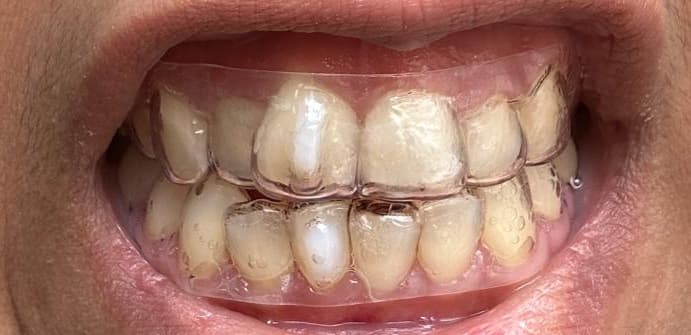
Most non-trivial aligner cases use attachments: tooth-coloured composite bumps bonded to specific faces so the plastic has something to push against. They are visible at conversational distance, especially on canines. They can stain. They are removed at the end, and the enamel underneath needs a polish. Ads that show a naked tooth in a transparent tray are often a mild case or a retouched one.
IPR — interproximal reduction — is the polite name for slicing a fraction of a millimetre of enamel between teeth to make room. It is common. It should be measured, not guessed. Done well, it is conservative. Done as a habit, it is enamel you will not get back. Ask how much, on which contacts, and why expansion or extraction is not the alternative.
Elastics from upper to lower, bite ramps, and “chewies” to seat a tray are ordinary. So are refinement scans when the teeth lag the plan. A quote that assumes one series and no refinements is an optimistic quote. Ask how many refinements are included, and what a new series costs if you are not a good wearer.
Whitening during treatment is a poor idea while attachments cover half the labial surface. You will bleach around the bumps. Read teeth whitening in Perth and wait until the composite is off and the retainers are in.
Hours, not intentions
Trays work when they are in the mouth. Most plans want about twenty to twenty-two hours a day. That means they come out for meals and tea, go back in, and do not live in a glovebox on the Kwinana Freeway. FIFO rosters, long shifts, and a social calendar that runs on grazing are the usual reasons Perth cases stall.
A lost tray is a phone call, not a week of “I’ll skip to the next one”. Jumping ahead is how you apply a force the tooth is not ready for. A cracked tray is the same phone call. Pets eat them. So do bin bags when you wrap them in a napkin at a pub in Fremantle.
Speech adapts in a few days for most adults. Lisping in week one is not a sign the case will fail. Sores from a rough edge are a trim, not a character test. If a tooth aches in a way that is not ordinary pressure — waking you, swelling, a bad taste — you need an examination, not the next number in the box.
Teenagers can do this well when someone checks the app and the calendar. They can also leave a series in a school bag. Compliance is a clinical fact. It should be discussed without theatre.
Retainers are the second treatment
When the last aligner finishes, the teeth are not “done”. Periodontal fibres reorganise slowly. Relapse starts quietly, often on lower incisors. Removable retainers — clear plastic similar to the last tray, or a Hawley with a wire — are commonly worn full-time for a short period, then nights. Many people need nights indefinitely. Fixed retainers are wires bonded behind the front teeth. They hold those teeth and they collect tartar. They can debond on one tooth and look fine until that tooth spins.
You will pay for retainers. You will pay again when you lose them at a beach camp or leave them on a plane from Karratha. A replacement pair in Perth in 2025–26, as a broad estimate, often sits in the low-to-mid hundreds of dollars; a bonded wire is a separate fee, and repairing it is another. Budget for this the way you budget for the aligners. The after braces piece is written for wires, but the relapse biology is the same.
Do not use the last aligner as a forever retainer unless your dentist has said that plastic is thick enough and the fit is still locked. Aligners fatigue. A floppy last tray is a souvenir, not a hold.
Specialists, general dentists, and scope
A general dentist can plan and supervise many aligner cases. Plenty do this carefully, with records, radiographs and a willingness to refer out. What they cannot do is borrow the title “orthodontist”. That title is a specialist registration. Look it up. Our editorial standards exist because a logo on a window is not a specialist qualification.
See a specialist when:
- the jaws do not match and camouflage would make the face or the gums pay
- a tooth is impacted or missing and space needs to be opened or closed with a plan
- there is a skeletal open bite, a severe deep bite, or a crossbite that is not a single tooth
- previous orthodontics failed and the reason is unclear
- you are a child with growth still to come and someone is selling adult-style trays
A referral is not a failure of the first dentist. It is the system working. If a shopfront scan leads straight to a finance agreement and no mention of records, keep walking.
Paediatric and adolescent treatment has its own timing. Early treatment is sometimes useful. It is also sometimes a way to start fees before the permanent teeth have finished arriving. Ask what this phase will achieve that waiting two years would not.
What it costs, and what extras pretend
Supervised clear aligner treatment in Perth in 2025–26 is commonly quoted from a few thousand dollars for a short, limited case into the mid-to-high thousands for a full comprehensive series, and higher when a specialist, extractions or a two-arch refinement marathon is involved. Limited “front teeth only” plans cost less and do less. Treat every figure here as an estimate. Laboratories, brand fees, records and retainers move the invoice.
Orthodontic extras, where they exist, are often a lifetime limit per person — a pot that looks large until you subtract a rebate of a few hundred or a couple of thousand from a comprehensive fee. Waiting periods of twelve months are common. Pre-existing rules appear. Read health fund extras in Perth and then call the fund with the item numbers on the quote. Hospital cover is irrelevant unless someone is planning surgery in a licensed facility.
CDBS does not pay for orthodontics. Do not spend a child’s two-year dental cap on examinations you could have used for fillings while you save for trays. The Child Dental Benefits Schedule is a different wallet.
Finance in the consult room is still a loan. Ask for the clinical plan in writing first, then decide how to pay. A weekly figure that looks like a streaming subscription is how five-figure dentistry hides.
A short method before you scan
- Have a full examination, including gums and, where indicated, radiographs — not only a pretty scan.
- Confirm who is registered and who you see if a tooth complains.
- Confirm attachments, IPR, elastics and how many refinements are included.
- Confirm hours of wear you can actually keep on your roster.
- Confirm retainer type, replacement cost, and the word “indefinitely”.
- Confirm whether a specialist should see the bite before plastic is printed.
If the case is truly mild and you can wear the trays, aligners are a reasonable tool. If the ad is the plan, the plan is incomplete.
This is general information about clear aligners as they usually meet Perth adults and teenagers, not a prescription for movement and not a comparison of brands. Your bite, gums and roots decide; a shopfront render does not.